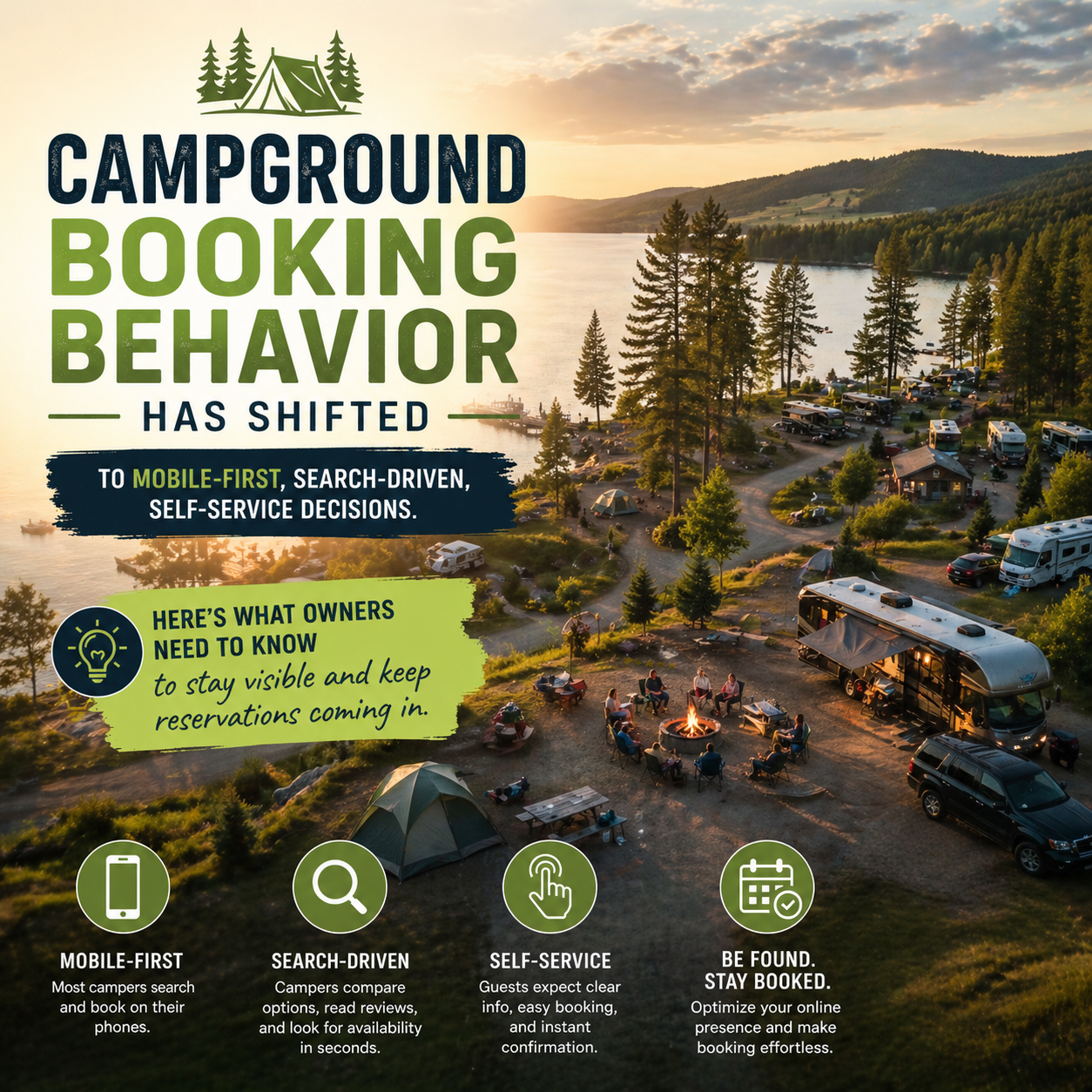

The way guests find and book campgrounds looks nothing like it did five years ago. If your marketing strategy hasn’t changed with it, you’re losing bookings to campgrounds that have — and you may not even know it. Campground booking behavior online is mobile-first, search-driven, and self-service oriented.
The phone-first era is over
For decades, campground bookings worked the same way. A guest saw an ad, got a recommendation from a friend, or found you in a directory. They called. You answered. You took the reservation.
That system still works — but it’s no longer the primary one. Today’s camper opens Google before they open their contacts. They search, scroll, compare, read reviews, look at photos, check availability, and either book online or move on. The entire decision can happen in under five minutes without a single human interaction.
A campground that still depends on the phone as its primary booking channel is dependent on guests who are motivated enough to search for a number, dial it, wait on hold, and talk to someone — when the campground down the road lets them book in three taps.
The guests haven’t disappeared. They’ve just changed how they decide.
Mobile search is now where bookings begin
The majority of campground searches happen on a phone. Not a desktop. Not a tablet. A phone, usually while someone is sitting on a couch thinking about their next trip, or standing in a parking lot after a conversation about summer plans.
That means your website needs to load in under three seconds, display cleanly on a 6-inch screen, and make the booking button impossible to miss. If any of those three things are broken, the guest doesn’t call to tell you — they just leave.
Test your own website on your phone right now. Navigate to it cold, as if you’ve never seen it. Try to find availability and book a site. Count how many taps it takes and how long it takes to load. If you wouldn’t complete that booking yourself, your guests aren’t completing it either.
Most campground owners have never done this test. The ones who have are usually surprised by what they find.
Google decides who gets seen — and most campgrounds don’t understand how
When someone searches “campgrounds near [your city]” or “best glamping in the Midwest,” Google is running a ranking decision in milliseconds. That decision is based on dozens of signals — your website structure, page load speed, the specific words on your pages, your Google Business Profile completeness, your review volume and recency, whether your site is mobile-friendly, and whether other credible sites link to yours.
Most campground owners built a website, published it, and assumed Google would handle the rest. That’s not how it works. Visibility is built deliberately through a process called search engine optimization — and it compounds over time. A campground that started building SEO signals two years ago is significantly harder to outrank than one that started last month.
The campgrounds showing up at the top of local searches didn’t get there by accident. They either hired someone who understood the system or spent years learning it themselves. Either way, the result is the same — they get seen first, and first is where most bookings come from.
Want to know exactly how your campground appears in search right now? The free visibility report at startersiteco.com shows you your current search presence, what Google sees when someone searches for a property like yours, and the top issues costing you visibility. It takes five minutes and costs nothing.
Third-party platforms are an opportunity and a trap
Hipcamp, Dyrt, Recreation.gov, RV Life, and Campspot are sending real booking traffic to campgrounds listed on them. If you’re not there, you’re invisible to a segment of travelers who start and end their search on those platforms and never visit Google at all.
But here’s what most campground owners don’t realize — third-party platforms own the guest relationship, not you. They take a cut of every booking. They control the communication. Third parties can change their algorithm, their fees, or their terms at any time. And if a guest books through Hipcamp and has a great stay, their loyalty is to Hipcamp, not necessarily to you.
The strongest campground marketing strategies use third-party platforms as a discovery layer — to get in front of new guests who wouldn’t have found you otherwise — and then convert those guests into direct bookers through your own website and email list. A simple post-stay email saying “Book direct next time and save 10%” is the beginning of owning that relationship back.
If you’re relying exclusively on third-party platforms you’re building your business on someone else’s land. The day their algorithm changes is the day your bookings drop.
Reviews now influence search rankings and booking decisions equally
Guests trust other guests more than they trust your website copy. A campground with 60 honest four-star reviews will consistently outperform a campground with a beautiful website and 8 reviews — because Google factors review volume and recency into local search rankings, and because guests factor reviews into their booking confidence.
There are three things that determine your review performance. How many reviews you have. How recent they are. And whether you respond to them — especially the negative ones. A professional, calm response to a one-star review tells every future guest reading it that you take your property seriously. Ignoring it tells them the opposite.
The campgrounds winning on reviews aren’t getting lucky. They have a system. A post-stay text message. A direct link to the Google review page. A simple ask that goes out automatically 24 hours after checkout. It takes about an afternoon to set up and compounds every single season because reviews never expire.
What about guests who find you but don’t book right away?
Not every visitor to your website books on the first visit. Some are planning months out. Some are comparing options. Sometimes they get interrupted and close the tab.
Most campground websites have no way to stay in front of those guests. They have no email capture. No retargeting. No reason for the guest to come back. So when they’re finally ready to book — two weeks, two months later — they start their search over from scratch and may end up at a different campground.
An email list changes this completely. A simple “Join our list for seasonal updates and early booking access” captures guests who are interested but not ready. A seasonal newsletter — one per quarter, nothing complicated — keeps your campground in their mind until they’re ready to commit. This is one of the highest-ROI marketing activities available to a campground owner and one of the least used.
The campgrounds filling their calendars share three things
They show up in search when guests look. Their website makes it easy to book when guests arrive. And they have a system to stay in front of guests who aren’t ready yet.
None of those three things require a big budget. They require the right structure, built once and maintained consistently.
If you want to know where your campground stands right now — what’s working, what’s broken, and what’s costing you bookings — start with the free visibility report. You’ll get a clear picture of current campground booking behavior online, your search presence, and the most important thing to fix first.
Leave a Reply