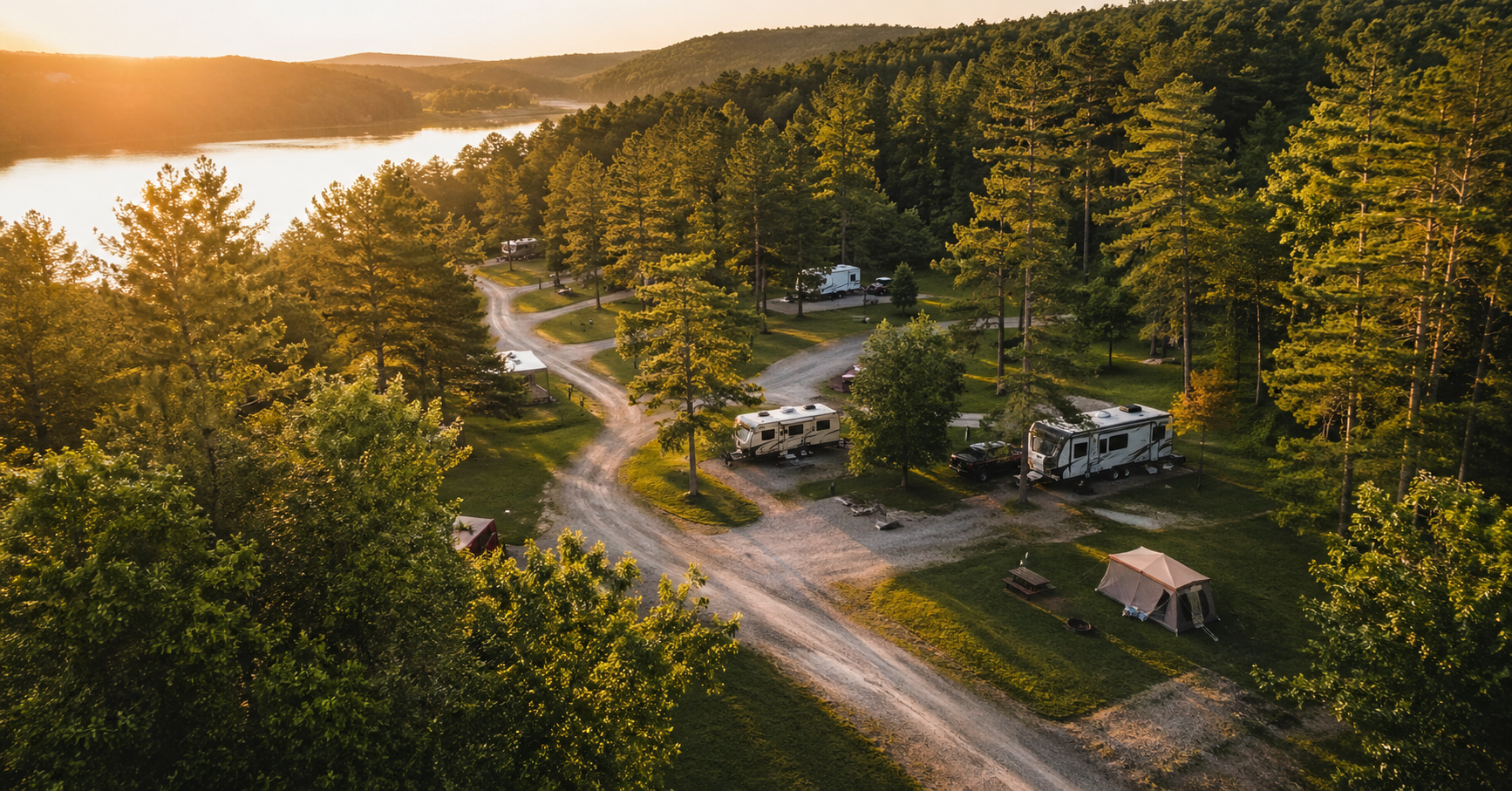

Most campground owners think Google is a mystery. It’s not. Google is actually trying to do one simple thing — send people to the best answer for their search. Once you understand that, everything about ranking starts to make sense.
Google has one job — and it’s not to help you
Here’s something most people in the outdoor hospitality industry have never been told.
Google does not care about your campground.
Google cares about the person searching for a campground. Its entire business model — billions of dollars in revenue — depends on giving that person the most relevant, trustworthy, useful result possible. Every time Google sends someone to a bad website, that person loses a little faith in Google. And a person who loses faith in Google starts using something else.
So Google is obsessive — almost paranoid — about sending people to the right place.
This is the best news you’ve ever heard as a campground owner. Because it means that if you can prove to Google that your campground is the most relevant, trustworthy, and useful result for someone searching in your area — Google will send them to you. Every time. For free. Forever.
That’s what SEO is. It’s not a trick. It’s not a hack. It’s the process of proving to Google that you deserve to be first.
Now let’s talk about exactly how you prove it.
Signal one — relevance: does your website say what people are searching for?
Google can’t visit your campground. It can’t smell the fire pits or feel the grass. All it can do is read your website.
So when someone searches “family campground with pool near Milwaukee,” Google reads every campground website it knows about and asks one question — which of these websites is most clearly about a family campground with a pool near Milwaukee?
If your website doesn’t say “family campground,” doesn’t mention your pool, and doesn’t clearly establish that you’re near Milwaukee — Google doesn’t send them to you. Not because Google doesn’t like you. Because Google genuinely doesn’t know you’re the answer.
This is why the words on your website matter more than the pictures. Photos make guests fall in love with your campground. Words tell Google what your campground is.
Every page on your website should clearly, specifically, and repeatedly describe what you offer, where you are, and who you’re for. Your homepage should not be a mystery. It should be the clearest possible answer to the question your ideal guest is typing into Google right now.
Most campground websites are not doing this. Most campground websites have a beautiful hero image, a tagline that sounds nice, and almost no text that tells Google anything useful. That’s why most campground websites don’t rank.
Signal two — authority: does Google trust your website?
Relevance gets you in the conversation. Authority determines where you rank in it.
Google measures authority in several ways. How long has your website existed. How many other credible websites link to yours. Whether your business information is consistent across the internet — same name, same address, same phone number on Google, Yelp, TripAdvisor, your Facebook page, and every directory that lists you.
Inconsistency is a trust killer. If your address appears three different ways across fifteen directories — one with “Road,” one with “Rd,” one with “Rd.” — Google sees conflicting information and reduces your authority score. It sounds small. The impact is not small.
Links from other websites act like votes of confidence. When a local tourism board links to your campground, when a blogger writes about their stay and links to your site, when a campground directory includes your listing with a link — each one tells Google that someone else on the internet thinks your campground is worth mentioning. The more votes you have from credible sources, the higher your authority climbs.
You build authority slowly and consistently. There are no shortcuts that work long-term. But every link you earn, every directory you’re listed in correctly, every piece of content that gets shared — it compounds. A campground that started building authority three years ago is significantly harder to outrank than one that started last month.
Signal three — proximity: are you close to where the searcher is?
This one you can’t change — but you can maximize it.
When someone searches “campgrounds near me,” Google uses their location to show results within a reasonable driving distance. Proximity matters. A campground 45 minutes away will almost always rank below one that’s 15 minutes away for that specific search.
But here’s what most campground owners miss — proximity to a city is a keyword, not just a map coordinate. If you’re 40 minutes from Chicago, you should have pages and content that explicitly say “campground near Chicago,” “day trip from Chicago,” “weekend getaway from Chicago.” Google needs to connect your location to the feeder cities your guests are actually coming from.
Remember — Chicago accounted for 3,400 active users on one Wisconsin campground’s website in a single year. Not because Chicago guests magically found it. Because the website told Google it was relevant to Chicago guests.
Your feeder city is your hidden keyword goldmine. Most campground owners never use it.
Signal four — Google Business Profile: your most underused ranking tool
Your Google Business Profile is the listing that shows up in Google Maps and in the map pack at the top of local search results. It is completely separate from your website. And it has its own ranking signals.
A complete, optimized, actively managed Google Business Profile ranks higher than a neglected one. Every section matters — your business description, your categories, your hours, your photos, your services, your attributes. Campgrounds that list amenities like “full hookups,” “pet friendly,” “WiFi,” “pool,” and “fire pits” show up for searches that include those terms. Campgrounds that leave those sections blank do not.
Photos are one of the most overlooked ranking factors in a Google Business Profile. Google shows profiles with more photos more often. Guests click on profiles with more photos more often. A campground with 200 photos of real sites, real guests, real sunsets, and real fire pits will outperform a campground with 12 photos every single time.
And reviews — volume, recency, and your response rate — feed directly into your local ranking. Every new review is a fresh signal to Google that your campground is active, relevant, and worth sending people to.
Signal five — experience: does your website make people stay or leave?
Google tracks what happens after it sends someone to your website. If they click your link and immediately hit the back button — that’s called a bounce, and it tells Google your website wasn’t what they were looking for. Too many bounces and your ranking drops.
If they click your link, spend three minutes reading, click through to your cabins page, then click through to your rates page — that tells Google your website is genuinely useful. Your ranking rises.
This means your website design is an SEO decision. A slow website loses rankings. A confusing website loses rankings. A beautiful, fast, easy-to-navigate website that clearly answers the questions a guest is asking — that website gains rankings over time.
Page load speed. Mobile friendliness. Clear navigation. Readable text. These are not just design preferences. They are ranking signals that Google measures on every visit.
The campground owner who understands this has an unfair advantage
Here’s the truth that most of your competitors don’t know yet.
Google ranking is not about luck. It’s not about who has the biggest budget. It’s not about who has the prettiest website. It’s about who has done the deliberate, consistent work of proving to Google that their campground is the most relevant, trustworthy, and useful result for their ideal guest’s search.
Most campground owners have never been told exactly what Google is looking for. Now you have. The question is what you do with it.
If you want to see exactly how your campground scores on these five signals right now — what’s strong, what’s broken, and what’s costing you the most bookings — start with the free visibility report at startersiteco.com. You’ll get a clear picture of where you stand and the single most important thing to fix first. It takes five minutes. It costs nothing. And it might be the most valuable five minutes you spend on your campground’s marketing this year.
Also read:
How campground booking behavior has changed — and what owners need to know
Leave a Reply