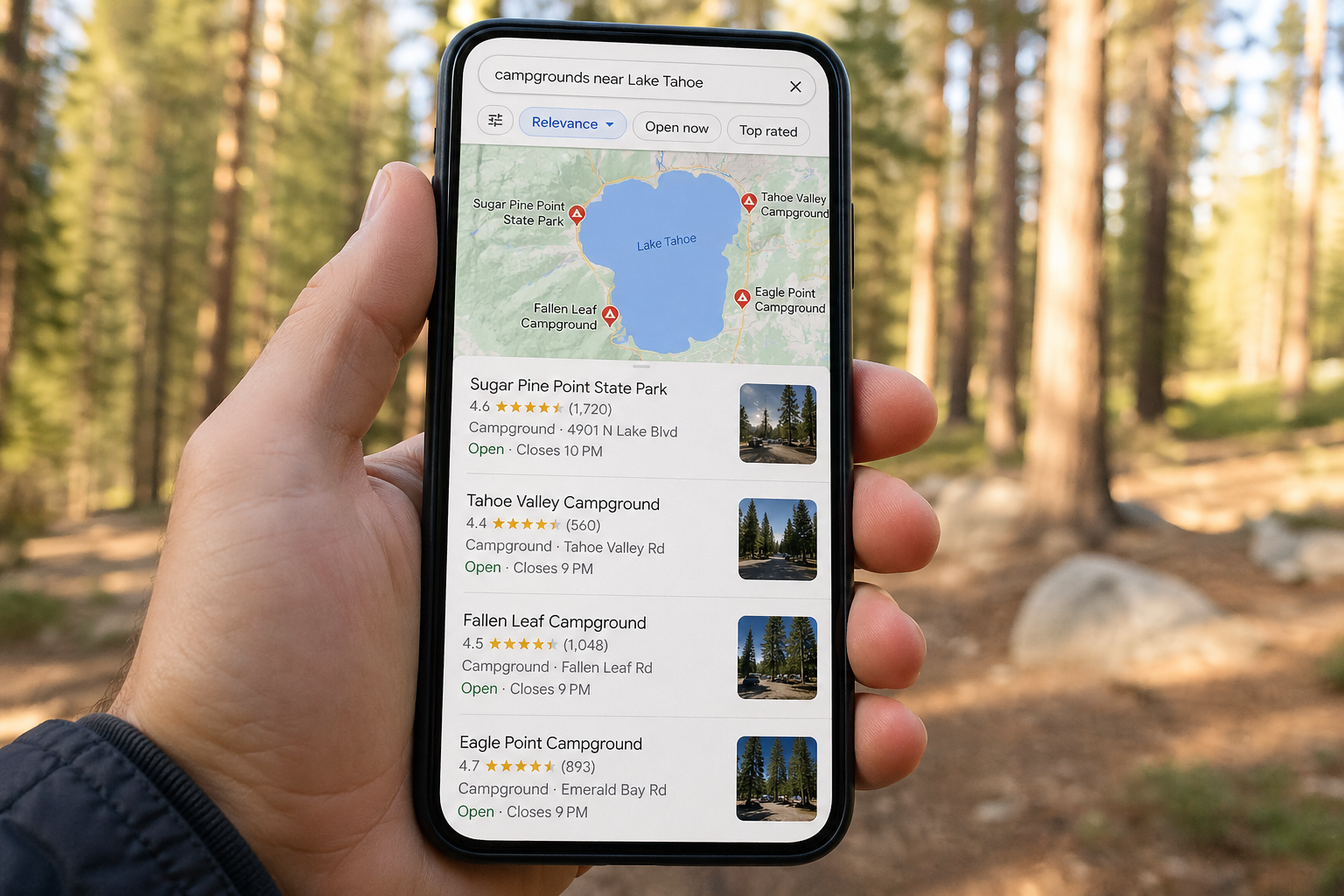

How to get your campground to show up on Google Maps
If someone searches “campgrounds near me” right now, your campground either shows up or it doesn’t. There’s no middle ground. And the campgrounds showing up first aren’t there by accident — they built a system that tells Google exactly where they are, what they offer, and why they deserve to be first. This article shows you exactly how to do the same thing.
Why Google Maps matters more than your website for campground bookings
Most campground owners spend their energy on their website. The website matters — but for local searches, Google Maps is where the decision happens first.
When someone types “campgrounds near [city]” or “campgrounds with hookups near me,” Google shows a map pack at the top of the results page. Three listings. A map. Star ratings. Distance. Phone number. Sometimes a direct booking link.
Most searchers never scroll past that map pack. They pick from those three results or they refine their search. If your campground isn’t in those three — you’re invisible to the majority of guests who would have been a perfect fit for your property.
Your Google Business Profile is what controls whether you appear in that map pack. It is completely separate from your website. You can have a beautiful website and still be invisible on Google Maps if your profile is incomplete, inconsistent, or neglected.
How to set up your Google Business Profile the right way
If you haven’t claimed your Google Business Profile yet — go to business.google.com right now and claim it before you read another word. Unclaimed profiles get lower visibility and you have no control over what appears on them.
Once you’ve claimed it, here’s what needs to be complete before anything else matters:
Your business name must match exactly — the same way it appears on your website, your Facebook page, your road sign, and every directory that lists you. Not “Nature’s Touch” on one and “Natures Touch Campground” on another. Exact. Consistent. Everywhere.
Your address must be precise. Use the physical address Google Maps can navigate to. If your entrance is on a different road than your mailing address, use the entrance address. Guests following Google Maps to a wrong location leave angry reviews.
Your phone number must be current and match every other listing of your business online.
Your website URL must link to your actual campground website — not a Facebook page, not a booking platform, your website.
Your hours must be accurate and updated for every season. A campground that shows “open” in January when it’s closed will get one-star reviews from confused guests and a ranking penalty from Google for inaccurate information.
Your primary category must be “Campground.” Secondary categories can include “RV Park,” “Glamping,” or “Cabin Rental” depending on what you offer.
The section most campground owners skip — and why it costs them rankings
Your Google Business Profile has an attributes section and a services section that most campground owners never fill out. This is one of the biggest missed opportunities in local campground marketing.
Attributes are the amenities and features guests filter by. Pet friendly. WiFi. Swimming pool. Full hookups. Picnic tables. Playground. Fire pits. Laundry facilities. Electric hookups. Water hookups. Each attribute you add becomes a search signal. When a guest filters Google Maps for “pet friendly campgrounds near me” — only campgrounds with the pet friendly attribute checked will appear.
Services work the same way. Tent camping. RV sites. Cabin rentals. Group camping. Event hosting. Day passes. The more specific and complete your services section is, the more search queries your profile becomes eligible to appear for.
Fill out every single attribute and service that applies to your campground. It takes 20 minutes and it expands the number of searches your profile can show up for overnight.
Photos — the ranking factor nobody talks about
Google measures photo engagement. Profiles with more photos get more views. Profiles with more views rank higher. This is not a theory — Google’s own documentation confirms that businesses with photos receive significantly more direction requests and website clicks than those without.
Most campground Google Business Profiles have between 8 and 20 photos. The campgrounds ranking in the top three in competitive markets often have 150 to 300 photos.
What to photograph: every site type, the entrance, the bathrooms and shower facilities, the pool, the playground, the camp store, fire rings, hookup connections, seasonal events, the view from your best sites, the sunset, the sunrise, the trees. Photograph everything a guest would want to see before they decide to book.
Upload photos consistently — not all at once. A profile that receives new photos regularly signals to Google that the business is active. Five new photos every two weeks outperforms 100 photos uploaded on one day.
Reviews — how to get them, how to respond, and why both affect your ranking
Review volume and recency are direct ranking factors in Google Maps. A campground with 200 reviews ranks higher than a campground with 40 reviews, all else being equal. A campground with 40 recent reviews ranks higher than one with 200 reviews from three years ago.
The best time to ask for a review is within 24 hours of checkout while the experience is fresh. A simple text message works better than email. Something like: “Thanks for staying with us this weekend. If you enjoyed your visit, we’d love a Google review — it helps other families find us. Here’s the direct link: [link].” That’s it. No pressure. No incentive. Just a direct, honest ask.
Responding to every review — positive and negative — tells Google your business is actively managed and tells future guests that you care. For negative reviews, respond calmly, professionally, and specifically. Don’t be defensive. Don’t argue. Acknowledge the experience, explain what happened if relevant, and invite them to reach out directly. Future guests reading that response will trust you more, not less.
Will AI search change how campgrounds get found?
This is the question campground owners should be asking right now — because the answer is already yes and it’s accelerating.
Tools like ChatGPT, Perplexity, and Google’s AI Overviews are changing how people research campgrounds. Instead of clicking through ten websites, travelers are asking AI assistants direct questions — “What are the best family campgrounds within two hours of Chicago?” — and getting a synthesized answer that may or may not include your campground.
The campgrounds that appear in AI search results share three characteristics. They have clear, structured information on their website that answers common questions directly. They have strong Google Business Profiles with complete information. And they have consistent reviews and mentions across multiple platforms.
This is called Answer Engine Optimization — or AEO — and it’s the next layer of visibility strategy that most campground owners haven’t heard of yet. The good news is that everything you do to rank on Google Maps also helps you appear in AI search results. The fundamentals are the same. Build a complete, accurate, consistent digital presence and both Google and AI tools will surface your campground when the right guest is looking.
How to know if your Google Maps presence is actually working
Your Google Business Profile has an insights section that shows you how many people found your profile, how they found it, and what they did next — called, visited your website, or asked for directions.
Check these numbers monthly. Direction requests and website clicks are the metrics that matter most. If those numbers are flat or declining, something in your profile needs attention — new photos, more reviews, updated attributes, or a profile description refresh.
If you want a complete picture of how your campground currently appears across Google Maps, search results, and your website — get the free visibility report at startersiteco.com. It takes five minutes, costs nothing, and shows you exactly what Google sees when someone searches for a campground like yours — and what’s preventing more of them from finding you.
You may also want to read: How campground booking behavior online has changed — and what owners need to know
Leave a Reply